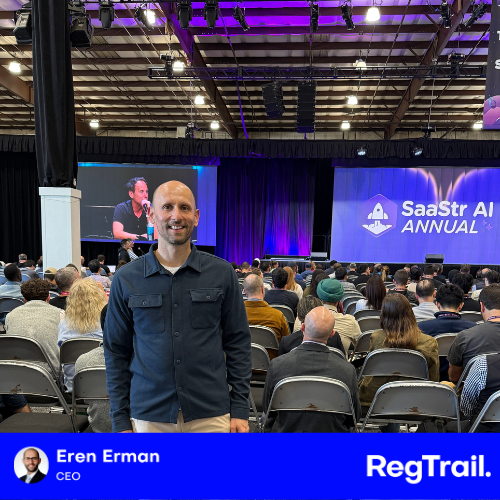
And that is a wrap! Three days at SaaStr in San Francisco and I'm buzzing with excitement having met so many inspiring founders and hearing so many unique stories about building the new world of Agentic AI.
My biggest takeaway is this: We are already living in the agentic AI shift. Being live in San Fran feels like I'm living in the future.
Every vendor is talking about agents. Every founder seems to be building with agents. Every conversation comes back to the same idea. Non-technical people can now build, test, automate, and launch workflows that previously required engineering teams. Replit provided live coding stations for anyone who wanted to build an agent on the fly.
That is exciting. It is also humbling.
The tools are becoming easier to use, but the learning curve is still real. Building useful agents still takes time, context, judgement, and a deep understanding of the workflow you are trying to improve.
One session really stayed with me. I listened to the CEO of Replit, Amjad Masad, and CEO of SaaStr, Jason Lemkin, talk about the future of AI and agents. The discussion made me think less about the tools and more about the future of work.
A few predictions feel increasingly real.
AI will start shaping strategy, not just supporting execution.
Managers will become agent managers. Their role will be to give agents the right context, review outputs, manage exceptions, and make sure automated work remains aligned with business objectives.
Operators will become workflow designers. The people closest to the process will have the power to redesign how work gets done.
Internal AI systems will become organisational knowledge engines. Imagine an AI that understands your policies, procedures, regulatory history, internal decisions, risk appetite, and past issues. That becomes a very different operating model.
The economics of work will also change. When agents can handle repetitive, data-heavy tasks at a fraction of the cost, firms will need to rethink where human judgement adds the most value.
For compliance and legal teams, this is not a distant conversation.
Energy and commodity trading compliance is full of repeatable, document-heavy, judgement-led workflows. Horizon scanning. Obligation mapping. Policy review. Surveillance triage. Case management. Regulatory change implementation.
Agentic AI will move into these workflows.
The real question is how firms redesign oversight, accountability, and control when AI starts recommending actions, assigning tasks, escalating issues, and shaping priorities. Roles and skills will change. I've talked about this before in previous Friday Filter posts.
I am seeing this shift happen in real time in San Francisco and it's blowing my mind.
It's only a matter of time before it reaches compliance and the future compliance operating model will not just be about more automation. It will be about humans, agents, controls, and accountability working together in a new collaborative working model.
.png)