Hungarian Energy Regulator MEKH fines Hungaro Energy for spoofing under REMIT
Hungarian regulator MEKH fines Hungaro Energy HUF 350 million for spoofing, highlighting the need for compliance in algorithmic trading practices.
Read the blog
The European Commission published its Gas Market Task Force's report on EU natural gas and gas derivatives markets, prepared jointly by ACER, DG ENER, ESMA, DG FISMA, DG COMP and DG CLIMA. It tests concentration concerns raised by the Draghi report and sets out fourteen findings covering REMIT enforcement, algorithmic trading, storage obligations, and data-sharing gaps between energy and financial regulators.
The report directly informs future EU energy and commodity derivatives policy, countering Draghi report claims of excessive concentration while flagging real gaps in REMIT enforcement, position reporting, and OTC visibility. It signals where ACER, ESMA and Member States will focus supervisory attention, shaping near-term compliance obligations for gas traders and market participants.
Concentration in TTF derivatives doesn't currently raise concerns, but REMIT enforcement is uneven across Member States, algorithmic trading needs closer monitoring, and OTC/third-country position visibility gaps persist. Compliance teams should review algorithm reporting under Implementing Regulation 2026/256 and prepare for enhanced venue-level scrutiny of large positions.
European Commission publishes Gas Market Task Force Report Highlighting Fourteen Findings That Are Shaping Future Compliance Priorities for European Energy Traders
On 2 June 2026, the European Commission (EC) published its report (click here) presenting its findings on the functioning of EU natural gas and gas derivatives markets.
The report was prepared by the Gas Market Task Force (GMTF) which is a cross-disciplinary group bringing together representatives from EU energy regulators (ACER, DG ENER), financial market regulators (ESMA, DG FISMA), the competition authority (DG COMP) and climate policy (DG CLIMA).
Further background on GMTF’s report
EU Commission report on the functioning of EU commodity derivative markets. The publication of the GMTF’s report follows the EU Commission’s recent report (click here) published on 26 May 2026 to the EU Parliament and Council assessing the functioning of EU commodity derivative markets pursuant to Article 90(5) of MiFID II and the need (or otherwise) for any changes to the existing commodity derivatives regulatory regime. That report, which was informed by the same February-April 2025 targeted consultation that fed into the GMTF's own analysis, concluded that there is no urgent need to make substantive changes to the existing commodity derivatives framework, although certain targeted adjustments may be considered in the future.
Both reports identify a common set of structural gaps in the current framework, including:
On these specific areas, the two reports point in the same direction.
The two documents differ in scope and emphasis. The EC commodity derivatives report covers a broader asset class extending beyond energy to metals, agriculture, and emission allowances and adopts a somewhat restrained posture across most areas reviewed. The GMTF report is a narrower deep dive into natural gas markets including natural gas derivatives, but it is more directive in its conclusions. In particular, its findings on REMIT enforcement gaps across Member States and the derivatives market impact of gas storage obligations falling outside the scope of the EC commodity derivatives report entirely. It also carries more immediate compliance implications for energy market participants.
ACER’s joint announcement on the GMTF report. In addition to the EC’s release of the GMTF’s report, ACER made a parallel announcement (click here) where it highlighted relevant areas of improvement identified by the GMTF. These include:
GMTF’s headline report conclusions
The report noted positive observations on the overall functioning of natural gas and gas derivatives markets while also highlighting observations which require further attention by Member States’ National Regulatory Authorities (NRAs) and Market Participants (MPs).
What is working well?
The report concluded that EU natural gas and gas derivatives markets are broadly functioning well with both the upstream and downstream EU wholesale gas supply markets exhibiting low levels of concentration. Also, there were no concerns related to position concentration in the crucial Dutch market Title Transfer Facility (TTF) derivatives traded on several EU venues. The GMTF report also noted that the current commodity derivatives framework is broadly considered fit for purpose.
The GMTF report conclusion was counter to that of the 2024 Draghi report (click here) which claimed there were high levels of concentration in natural gas trading markets and recommended that they should be further regulated under a single EU trading rule book. Reference in the Draghi report was also made to financial position limits, dynamic caps, the ancillary activity exemption, transparency and the obligation to trade in the EU. Furthermore, the Draghi report recommended that the EU should further integrate the regulatory and supervision framework for financial markets for energy. The report also pointed to better information exchanges, coordination and cooperation between energy and financial regulators (page 31, paragraph 73).
The GMTF's own analysis directly tests the Draghi report's claims of excessive concentration in gas trading markets. The results show a fragmented market at both upstream and downstream levels, and TTF position concentrations that have trended lower since 2022. The GMTF concluded that "the degree of concentration in positions, including during crisis periods, did not and still does not raise any concerns" (page 35, paragraph 92).
The GMTF findings provide a degree of reassurance to market participants and regulators that concentration levels in EU gas and gas derivatives markets do not, at present, raise concerns about orderly market functioning though the report makes clear that active monitoring remains a priority.
What is not working well?
The findings highlighted patterns rather than one-off concerns which point to potential systematic risks that need to be addressed.
Overview of GMTF report structure
The GMTF sets its analysis against a shifting natural gas landscape. Russian pipeline gas has fallen from 42% of EU supply in 2021 to 12% by Q3 2025 (page 9, paragraph 6). Liquefied natural gas (LNG) now accounts for around 40% of EU gas supply. The 2026 Gulf crisis, following military strikes on Qatar's Ras Laffan complex, has interrupted LNG flows, driven TTF prices up by around 42% since the conflict began, and reactivated supply security concerns that regulators should not ignore (pages 16-17, paragraphs 25-27).
The first half of the GMTF’s report (pages 1-37) provides an overview covering several useful themes to help compliance analysts better understand the European natural gas and gas derivatives markets including:
The second half of the report presents the analytical work of the GMTF and concludes with the fourteen specific findings and recommendations as summarised on pages 5-6 of the report:
Finding 1: It is important that the Commission, together with EU and national authorities with regulatory and oversight powers for gas and gas derivatives markets, continues to actively monitor, as a matter of priority, the market developments at all levels of the natural gas supply chain.
Finding 2: It would be valuable for the Commission to work closely with ACER to develop new data-screening tools leveraging the REMIT database.
Finding 3: It would be beneficial for the Commission to engage with ACER, ESMA and the relevant national authorities in a structured dialogue and data exchanges, with a focus on the use of algorithmic trading tools, including AI-based algorithms and their impact on trading activity and, in particular, on the price formation of gas and gas derivatives.
Finding 4: It is essential that market participants take the necessary measures to be ready for timely compliance with the obligations in the revised REMIT Implementing Regulation.
Finding 5: It is essential that Member States ensure effective and timely implementation of REMIT.
Finding 6: It is important that Member States ensure that their national regulatory authorities are equipped with all the necessary human and financial resources to carry out REMIT tasks.
Finding 7: It would be valuable to increase the effectiveness of MiFID position reporting by giving national competent authorities access to end- position holders.
Finding 8: It would be valuable for trading venues to have access to a broader set of OTC derivative data for position management control purposes.
Finding 9: It is valuable to ensure a level playing field in position limits by clarifying the scope of position limit reporting.
Finding 10: The procedure for granting hedging or liquidity provision exemptions could be made more agile.
Finding 11: The Commission could consider setting up a one-off notification for entities trading under the ancillary activity exemption (AAE).
Finding 12: It would be valuable for Member States to ensure storage obligations that they implement have a minimal impact on the functioning of derivatives markets.
Finding 13: It would be valuable for ACER and ESMA to create a workstream to ensure more efficient data use and improve the data-sharing framework across entities and regulations.
Finding 14: Market supervision could be enhanced by improving ACER/ESMA cooperation.
We review the findings of the GMTF report in detail and focus on the following six themes:
Theme 1: Market Concentration - The GMTF's Response to the Draghi Report.
One of the primary reasons the GMTF was established was to test the Draghi report's claim that the gas derivatives market is characterised by a high degree of concentration. The Draghi report cited an ESMA analysis finding that the top five companies hold around 60% of positions on some trading venues (page 31, paragraph 74). The GMTF conducted its own structural mapping of EU upstream and downstream wholesale gas supply markets, based on all gas and gas derivatives transactions with a 2024 delivery date, and the results diverge substantially from the Draghi report's characterisation.
At the upstream level covering first commercial sales of natural gas, the top three players account for a combined market share of approximately 40–50%, with the remainder of the market described as "very" fragmented (page 34, paragraph 88). The LNG sub-segment is more concentrated, with the three largest players accounting for slightly over 50-60%, while the piped natural gas (PNG) sub-segment shows the three largest at around 60–70%, though conclusions are consistent across both sub-segments.
At the downstream level, assessed by the sum of buy and sell trades across EU gas exchanges, the market features thousands of participants. Only two hold market shares within the 5%–20% range. An alternative net-long position assessment reached the same conclusion (page 35, paragraph 89).
On TTF derivatives concentration specifically, the GMTF used anonymised end-of-month position data from ICE Endex covering July-November 2022 at peak crisis and October 2023-October 2024 as a quieter reference period. In November 2022, the height of the energy crisis, concentration levels were around 25% for the top five position holders and 50% for the top ten. The GMTF concluded that these levels did not raise concerns. Post-crisis, concentration trended lower, attributed to the return of market participants following falls in price and associated margin requirements (page 35, paragraphs 90–93).
The report concludes at page 35, paragraph 92:
Drawing on the above analysis, the GMTF has concluded that the degree of concentration in positions, including during crisis periods, did not and still does not raise any concerns
 RegTrail Insights
The GMTF's finding materially reduces the probability of imminent regulatory intervention targeting structural market concentrations. Position caps directed at particular firms or forced divestiture based on concentration concerns are not supported by the analysis. However, the GMTF's proposed development of continuous Herfindahl– Hirschman Index (HHI)-based screening tools using the REMIT database (Finding 2) means that concentration monitoring may now be built into the EC/ACER surveillance apparatus on an ongoing basis. Market participants whose positions move them into the top decile of position holders on any given contract should expect greater regulatory scrutiny, even absent any formal position limit breaches, and should retain clear records of the commercial rationale for position-building activity.
The ESMA analysis cited in the Draghi report used 2022 crisis-period data and acknowledged limitations around non-EU counterparty positions. The GMTF's dataset is broader and more recent however it still does not mean the concentration question is permanently settled particularly as the 2026 Gulf crisis tightens global LNG markets and could produce new concentration dynamics in spot procurement but it provides a robust baseline against which future monitoring will be measured.
Theme 2: Algorithmic trading and emerging surveillance risks.
The GMTF report noted that algorithmic trading is now the prevalent form of trading in key EU gas benchmarks (page 20, paragraph 36) and acknowledged the benefits it brings to gas markets including its contribution to liquidity and making the trading process more efficient, reliable and responsive to real-time market conditions (page 36, paragraph 94). High-frequency trading (HFT) and AI-based algorithms were seen as particularly relevant in dynamic, volatile gas markets where participants must regularly adapt.
The report drew its findings based on publicly available literature, including a 2024 joint study by the Dutch NRA (ACM) and financial markets authority (AFM), to map both the benefits and risks of algorithmic tools (click here).
The GMTF report identified three categories of risk associated with the improper use of algorithms:
The report stressed in Finding 3 that enhanced cooperation is required between competent authorities specifically the EC, ACER, ESMA, and relevant national authorities, including both national competent authorities (NCAs) and national regulatory authorities (NRAs) to monitor how algorithmic tools affect the functioning of commodity and commodity derivatives markets. The GMTF stresses cooperation between both financial and energy authorities as algorithmic trading in gas markets sits under MiFID II (as a financial market activity) and under REMIT (as wholesale energy market activity). Neither regulator has full visibility without active cooperation from the other.
The GMTF acknowledged that algorithmic trading has become widespread in commodity and commodity derivatives markets and is a highly dynamic market feature that is constantly evolving. Competent authorities are called on to keep pace with these developments particularly regarding HFT and AI-based tools to ensure their supervisory frameworks remain adequate. The report proposes that this be pursued through structured dialogue and data exchanges focused on the use of algorithmic tools and their impact on price formation in gas and gas derivatives markets.
Additional risks were also noted related to the behaviour of AI-based trading tools, including:
RegTrail InsightsAlgorithm Reporting Obligations. Beyond the surveillance obligations placed on competent authorities, market participants using algorithmic tools in EU gas markets face a concrete and already-in-force reporting obligation that this week's report specifically flags under Finding 4. REMIT II introduced a requirement for MPs to report to ACER and the relevant NRA on their use of algorithms when carrying out trading activity (page 25, paragraph 56). This obligation was operationalised by EC's Implementing Regulation (EU) 2026/256, adopted on 30 January 2026.
Theme 3 - REMIT II implementation and enforcement gaps across Member States.
GMTF emphasised in its report that the revised REMIT Implementing Regulation plays a significant role in market supervision. Finding 4 (Timely compliance with the obligations in the revised REMIT Implementing Regulation) and Finding 5 (Effective and timely implementation of REMIT) both reiterate the need to fully implement and operationalise the REMIT framework.
The EC sent a detailed questionnaire to all 27 Member States following a webinar on 19 June 2025. Twenty-two Member States responded while five did not (page 32, paragraph 82).
The findings were illuminating:
The report on page 38 (paragraph 99), summarised the EC’s findings on the current state of NRA capacity to step up their investment in resources to enforce market abuse cases:
In some Member States, national regulatory authorities do not have the necessary investigatory and/or enforcement powers. In others, national regulatory authorities are not equipped with sufficient personnel or lack the necessary expertise to enforce market abuse cases. Many Member States stated that they were in the process of updating their national legislation so as to become REMIT-compliant by 2026.
RegTrail InsightsWhile the report highlights that there is uncertainty over whether certain Member States can fully implement and operationalise REMIT effectively for the reasons noted above, uneven REMIT enforcement creates an unlevel playing field in wholesale energy markets – something most market participants are fully aware of given recent REMIT enforcement decisions over the past 24 months in particular EU countries.
REMIT II was legislated to create a more level playing field across Member States in terms of harmonised enforcement and market abuse monitoring. While the observations from this report were based on a Member State survey from 2025, it re-affirms that there is still regulatory fragmentation across certain jurisdictions. The report doesn’t explicitly name which Member States are behind in their REMIT implementation which is perhaps not surprising given that would potentially be a transparent roadmap for regulatory arbitrage!
Theme 4: Relationship between gas storage obligations and derivatives markets.
The interaction between the mandatory gas storage obligations and derivatives market dynamics received significant attention in the GMTF report. The core report finding was that where storage-filling entities buy heavily in spot markets without corresponding forward sales in the derivatives market, they create one-sided demand pressure that amplifies price volatility in the gas futures curve (page 46, paragraph 135).
Regulatory news impacting gas storage spreads. The report provided an illustration of this with a specific market event. On 18 February 2025, when the gas storage framework included mandatory filling trajectories, a news source published a draft of the Clean Industrial Deal communication suggesting the EC would adopt "dynamic" storage-filling targets. Large intraday swings in the summer/winter spread were observed on that day - market participants appeared to have responded immediately to regulatory uncertainty about future storage rules (page 45, paragraph 133). The report was careful to note that correlation does not imply causation, and that other factors such as supply scarcity and the end of the Ukraine gas transit were also at play that day.
The figure below illustrates the development of the summer/winter spread on 18 February 2025. Over that day, a news source published a draft of the Clean Industrial Deal communication, stating that the Commission would work together with Member States on storage filling ‘in the context of the gas storage regulation extension’ and that ‘the new approach to gas storage filling would include “dynamic” targets to help support summer preparedness’ (News 1), which was then corrected (News 2). Large intraday variations in the summer/winter spread and trading activity were observed – possibly due to rumours regarding the future rules. However, other drivers continued to influence the summer/winter spread over that day, leading the spread to continue to climb and leaving the overall trend unchanged (page 45, paragraph 133)
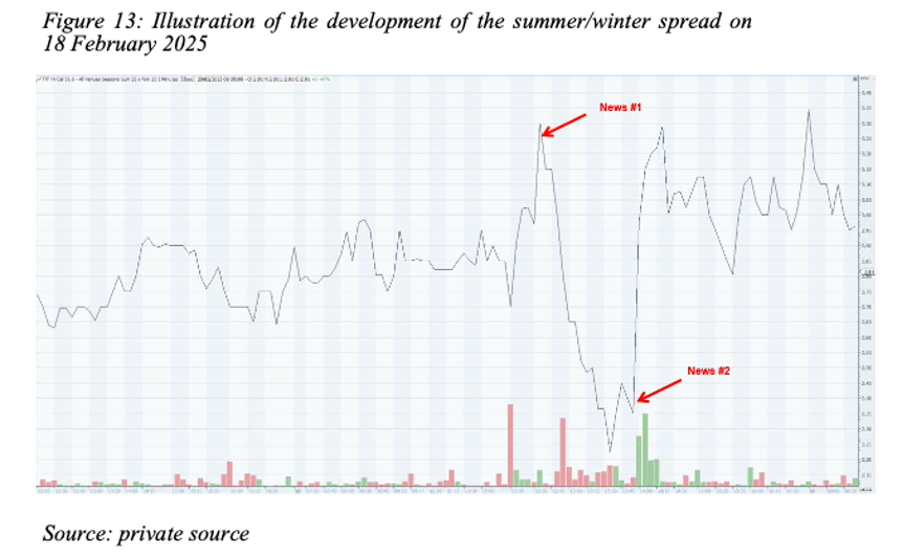
GMTF Report - Figure 13
The report noted on page 45, paragraph 134 that "this immediate reaction underscores the significance of carefully calibrated national implementation measures for gas storage targets to avoid unintended price distortions".
Gas SOS Regulation changes – revised gas storage filling requirements for securing gas supplies ahead of the EU winter season. Additionally, the report reminds readers of the recent amendments to the EU gas storage framework, specifically the 2025 amending Regulation (EU) 2025/1733 (click here), which have already inserted further elements of flexibility into its design, including making filling trajectories indicative rather than mandatory and granting Member States the ability to deviate from filling targets in defined circumstances such as periods of market stress or low seasonal price spreads (page 30, paragraphs 67-70).
Finding 12 of the report concludes by calling on all Member States to ensure that firms with storage-filling obligations have access to futures markets and the capability to implement appropriate hedging strategies. It also recommends coordination between energy and financial regulators during storage-filling periods (page 54, paragraphs 181-182).
Theme 5 – Data sharing across reporting regimes, interoperability, and ACER/ESMA cooperation
The architecture of EU regulatory reporting for gas markets produces parallel, partially overlapping data streams. ACER and NRAs receive transaction data through REMIT. ACER also has access to some EMIR trade repository data under EMIR's data-sharing provisions. ESMA and NCAs receive transaction and position data reported under MiFIR and EMIR for financial instruments including gas derivatives. The result is that energy regulators cannot always access data held by financial regulators, and vice versa (pages 39-40, paragraphs 107-108).
REMIT II expanded the data-sharing obligation by requiring ACER to set up mechanisms for sharing data with the EC, ESMA, Eurofisc, NRAs, NCAs, national competition authorities, and other relevant authorities. EMIR separately requires trade repositories to provide direct access to ACER and other public authorities to enable them to fulfil their respective mandates. Together these provisions are designed to ensure that data centrally reported to ACER is available not only for ACER's own surveillance activities but also for the tasks of the other regulators listed above (page 40, paragraph 108). Stakeholders in the targeted consultation were sceptical about a single reporting mechanism, citing implementation costs and the fact that each framework serves different purposes (pages 40-41, paragraphs 110-111).
The preferred direction, endorsed by the GMTF, is improved interoperability of existing datasets rather than new reporting requirements. Common identifiers appear as a prerequisite. The interoperability exercise GMTF notes requires mapping data fields across regimes to identify misalignments in labelling and terminology, and the road map should build on internationally recognised industrial standards and identifiers (page 56, paragraph 186).
Stakeholders suggested mirroring REMIT's data-sharing provisions in the financial rule book to create symmetric frameworks in both pieces of legislation (page 41, paragraph 112). The GMTF agreed with this assessment. Finding 13 at page 55 calls for a joint ACER/ESMA workstream to:
Map data fields for interoperability;The workstream's output, a data mapping exercise and related road map, would be submitted to the EC in the form of a report (page 56, paragraph 186).
The GMTF expressed on page 56, paragraph 186, the practical reality of streamlining the relevant datasets, noting that it would require a thorough review of all datasets including orders, transactions, positions, and exposures.
(186) In order to improve the interoperability of data, a thorough review of all the relevant datasets (orders, transactions, positions and exposures) stemming from the relevant reporting regimes would be necessary. The various items of information contained within each dataset would need to be mapped, in order to identify both misalignments in labelling/terminology and potential areas for harmonisation.
Such a review requires expertise from both financial and energy markets, and it should therefore be undertaken by ACER and ESMA jointly. Where misalignments in terminology, reporting guidance or other discrepancies in reported data are identified, a deeper analysis is needed in order to ensure that what is collected fulfils the purpose and is useful for the mandates of the various authorities and regulators.
The GMTF also sees added value in this exercise, including with regard to the master data or reference data collected and maintained under the various regimes, as well as technical standards and formats. On the basis of the mapping exercise, ACER and ESMA could jointly draw up a road map towards a more interoperable and streamlined reporting framework that builds on internationally recognised industrial standards and identifiers. The result of the mapping exercise and the road map would be submitted to the Commission in the form of a report.
(187) Building on the principles of simplification and burden reduction, the GMTF believes that the focus should be on leveraging existing reporting flows and infrastructures rather than creating new requirements, institutionalising and operationalising the exchange of data as appropriate, although the outcome of that exercise may point to the need to implement certain legislative changes.” (page 56, paragraph 187)
RegTrail InsightsThree specific aspects of the data interoperability challenge are worth noting for compliance practitioners.
The durability of any interoperability improvements will therefore depend on whether the EC and co-legislators treat REMIT implementing regulations and MiFIR technical standards as part of a coordinated review cycle rather than separate workstreams.
Finding 14 goes further, calling on ACER and ESMA to assess joint guidance in areas of shared responsibility, explore a single notification system for products that are both wholesale energy products and financial instruments, and consider institutionalising their existing joint task force as a formal joint committee (pages 56-57, paragraphs 189-194).
RegTrail InsightsThose familiar with the report on the functioning of EU commodity derivative markets by the EC (referenced in the introduction above) will recognise the theme of data harmonisation although the report stressed the need for a comprehensive cost benefit analysis of such harmonisation given the effort it would entail. As highlighted in this report, market participants are, in many cases, seeking more alignment of data across regimes to reduce reporting burden but are not supportive of costly workstreams to align reporting frameworks. The onus is now on ACER and ESMA to identify methods of setting up data feeds to enable data exchange through existing data-sharing frameworks.
Finding 14 calls on ACER and ESMA to identify areas for improved cooperation through the existing ACER/ESMA Task Force and specifically invites them to consider whether that existing joint task force should be institutionalised as a formal joint committee reporting directly to the directors of ACER and ESMA. Such a committee would be supported by a legal framework enabling it to issue joint guidance in areas of shared responsibility, without disrupting the current governance balance between energy and financial regulation (page 57, paragraph 194).
One such initiative is a shared and centralised notification system of wholesale energy products that are also financial instruments for persons professionally arranging or executing orders or transactions (PPAETs), algorithmic traders and direct electronic access providers (DEAs) which would reduce duplication, inconsistencies and help align regime updates. This would allow for information to be exchanged in real time and reduce duplication of requests and reduce administrative burden for both market participants and regulators.
Theme 6: Position reporting and OTC visibility gaps.
The GMTF identifies two specific structural gaps in the position oversight framework, both of which affect regulators' ability to form an accurate picture of exposures in gas derivatives markets.
On the process for granting hedging and liquidity provision exemptions from position limits, 57% of consultation respondents suggested that the granting of hedging and liquidity provision exemptions from position limits should move from NCAs to trading venues, on the basis that venues are better placed to assess whether positions reflect genuine hedging activity (page 43, paragraph 123). The GMTF supports this in principle, subject to safeguards including systematic reporting to and regular review by NCAs (pages 53-54, paragraphs 174-177).
GMTF findings. Theme 5 straddles Finding 8 (granting trading venues access to a broader set of OTC data for position management control purposes) and Finding 9 (clarifying the scope of position limit reporting). It also introduces recommendations in Finding 10 related to the process by MPs to request position limit exemptions.
Finding 8 on page 51 recommended that trading venues be granted enhanced powers to request information held in a broader set of OTC contracts related to commodity derivatives.
Finding 9 on page 52 provides a further overview of the legal uncertainty for positions taken by EU investment firms and their clients on third-country venues:
(167) The current MiFID position limits regime is subject to legal uncertainty as regards positions taken by EU investment firms and their clients on third-country venues offering trading in economically equivalent commodity derivative contracts and the extent to which such positions should be reported and count towards position limits, where contracts are subject to limits in the EU.
PMCs complement position limits and act as arrangements trading venues put in place to monitor open positions of market participants. Two limitations were identified that affect position management control effectiveness and position reporting framework.
The GMTF suggested that it would be valuable to clarify that all positions held by EU investment firms and their clients in economically equivalent contracts traded outside an EU trading venue count towards the position limits and would therefore be subject to the same treatment as positions in contracts traded on EU venues. This clarification would also apply to bilaterally traded economically equivalent contracts, or economically equivalent contracts traded on a non-EU trading venue. This clarification removes unintended incentives for trading outside the EU and preventing circumvention of EU rules and creating a level playing field for all third country venues.
Finding 10 of the report (Making the procedure for granting hedging or liquidity provision exemptions more agile) highlighted the need for a better application procedure to obtain hedging and liquidity provision exemptions from position limits which are currently granted by NCAs. Based on input received from MPs, the GMTF proposed that a new procedure could be considered where MPs, or brokers on their behalf, would apply directly to a trading venue for the exception and the trading venue would review the application and grant the exemption when the application complies with the relevant legal conditions.
Finally, Finding 11 (One-off notification for entities trading under the Ancillary Activity Exemption [AAE]) proposes that the Commission consider requiring all entities trading under the AAE to submit a one-off notification to NCAs when they start and cease operations in commodity derivatives markets. Regulators currently have limited visibility over which entities are relying on the AAE at any given time, since the 2021 Capital Markets Recovery Package removed the previous annual notification requirement. The GMTF recommends that a one-off notification at commencement and cessation would restore a baseline level of supervisory visibility without reimposing an ongoing reporting burden (page 54, paragraphs 178–179).
It further notes that this should be structured to impose "the lightest possible regulatory burden for entities" and should take into account existing reporting obligations and mechanisms.
Separately, the 26 May 2026 EC commodity derivatives report goes further, indicating that the Commission could consider a one-off notification requirement for all entities active in commodity derivatives markets when starting and ceasing operations, not only those relying on the AAE. Taken together, both proposals point in the same direction. Regulators want better visibility over who is participating in commodity derivatives markets and on what regulatory basis.
Firms currently benefiting from the AAE should monitor whether this proposal advances into legislation and prepare for a potential change in notification process.
RegTrail InsightsAgain, those familiar with the recent report on the functioning of EU commodity derivative markets by the EC (referenced above) will be familiar with these issues and potential remedies. Firms routing positions through non-EU entities whether for structural or tax reasons should be aware that regulators are actively seeking to close the visibility gap this creates. Legislative change is required for both the third-country reporting extension and the expanded OTC data request power for trading venues, so these are medium-term rather than immediate obligations. However, trading venues may gain the power to request broader OTC data on an ad hoc basis particularly during periods of market stress or heightened risk should an updated delegated act be promulgated.
Energy firms using OTC positions to hedge physical gas exposures should document the commercial rationale and hedging relationship for those positions carefully, as increased venue-level data requests will require clear explanations when accountability levels are approached.
Take a short tour of the RegTrail Insights Platform with a free trial for a limited time.