Swiss Council Approves VATE Ordinance – Six Compliance Priorities for Energy Traders
Share:
What Is It About
The Swiss Federal Council has approved VATE, implementing BATE, Switzerland’s new wholesale energy market supervision framework. The Ordinance sets out requirements for market registration, transaction and risk-position reporting, inside-information disclosure and supervisory oversight by ElCom.
Why It's Important
The new framework introduces separate Swiss compliance obligations for firms trading Swiss wholesale energy products, regardless of where they are based. Although existing EU REMIT processes can support implementation, firms must account for differences in reporting requirements, deadlines and supervisory arrangements.
Key Takeaways
Firms should identify affected entities and contracts, assess scope and exemptions, allocate reporting responsibilities and review inside-information controls. They should also prepare for ElCom registration, reporting and data requirements ahead of BATE and VATE entering into force on 1 January 2027.
On 2 October 2026, Switzerland’s Federal Council approved VATE, the Ordinance on Supervision and Transparency in the Wholesale Energy Markets (click here). VATE implements the Federal Act on Supervision and Transparency in the Wholesale Energy Markets (commonly referred to as "BATE", its Swiss-German acronym).
Documents accompanying the announcement
The announcement is accompanied by three documents, all of which are in Swiss German – please contact RegTrail using this contact form if you would like English-translated versions:
The approved ordinance (VATE) (“O”) sets out the detailed rules for registration, disclosure, reporting, supervisory charges and transitional arrangements (click here).
The explanatory report (“E”) explains the reasoning behind each provision and gives worked examples that help firms interpret the requirements (click here).
The consultation report (“C”) summarises 52 submissions from the 262 stakeholders invited to comment between 28 January and 5 May 2026 (click here). Respondents focused on implementation time, deadlines for complex contracts and the proportionality of gas-sector obligations. The report summarises comments but does not state which were adopted (Doc: C, PDF p.3-4, sections 1.2-2.1).
References use PDF page numbers in the English-translated versions referenced above. “O” denotes VATE, “E” the explanatory report, “C” the consultation report and “T” RegTrail’s interpretation of discussions held at the ETRC session in London in September (see below). Note that the definitive version of the final Ordinance will be published on Fedlex, the Swiss federal government's official platform for federal legislation (click here).
VATE at a glance
BATE and VATE enter into force on 1 January 2027, and individual obligations follow the phased timetable explained in Theme 6. ElCom will oversee compliance with the new framework. Its responsibilities include registering market participants and authorising reporting mechanisms and inside-information platforms. It will also analyse market data to monitor trading activity and investigate suspected breaches (Doc: O, PDF p.4-10 and 24-28, Articles 5-17 and 34-42; E, PDF p.3, section 1.2).
Existing processes under the EU's Regulation on Wholesale Energy Market Integrity and Transparency (REMIT) provide a useful starting point. For Compliance and Legal, the immediate work involves identifying affected entities and contracts, checking exemptions, allocating reporting responsibilities and preparing conduct controls (Doc: E, PDF p.7-10, sections 3.1-3.2).
The Swiss Federal Office of Energy (SFOE) estimates that around 250 energy traders, 700 network operators and other suppliers and a limited number of large end users will fall within BATE (Doc: E, PDF p.9, section 3.2).
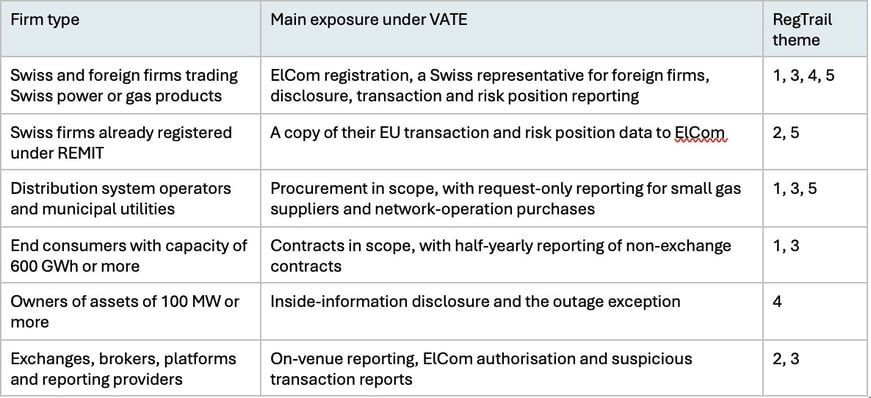
Table 1. VATE exposure by firm type
Insights from ETRC at Energy Trading Week
RegTrail attended Energy Trading Week Europe in London on 24-25 September 2026, shortly before VATE’s approval. At its ETRC Risk & Compliance Conference stream, Cornelia Kawann, ElCom’s Head of Market Surveillance, discussed ElCom’s preparations for BATE. She highlighted the new enforcement powers and described the legal basis for cooperation with European regulators and the EU Agency for the Cooperation of Energy Regulators (ACER) in cross-border investigations. Themes 2 and 3 draw on Ms Kawann’s remarks (T).
We review the approved VATE provisions through six themes, which follow the order in which a firm meets the regime.
Theme 1 - BATE covers firms trading Swiss wholesale energy products regardless of where they are based.
Theme 2 - Existing REMIT processes can support compliance with separate Swiss requirements applying.
Theme 3 - Reporting responsibility depends on the contract and how it is traded or amended.
Theme 4 - Inside information creates disclosure duties and trading restrictions.
Theme 6 - Phased implementation requires firms to separate data capture requirements from submission deadlines.
Further guidance and technical requirements
The explanatory report expects ElCom to issue guidelines on the operational detail of registration, provider authorisation, inside-information publication, transaction and lifecycle-event reporting, risk positions and fundamental data. ElCom must take ACER’s guidelines into account and base its forms on ACER’s forms (Doc: O, PDF p.2-3, Articles 3-4; E, PDF p. 10-11, section 3.3).
ElCom’s guidelines are not binding. Under Article 40, the SFOE can issue binding technical and administrative requirements, including how information must be formatted and transmitted and which security standards apply. The SFOE may also declare ElCom directives, ACER recommendations and international standards binding, normally after consulting stakeholders (Doc: O, PDF p.27, Art.40; E, PDF p.75).
At ETRC, Ms Kawann suggested that algorithmic-trading guidance could follow in 2028. This was a tentative indication rather than a confirmed publication timetable (T).
Additional topics covered by the documents
Supervisory funding. ElCom charges CHF 100-250 per hour for services and levies an annual charge comprising a CHF 250 basic levy and a variable levy allocated by each participant’s share of submissions (Doc: O, PDF p. 20-22, Articles 26-32; E, PDF p.60-63).
Fundamental data. Only Swissgrid and Swiss gas transmission operators submit fundamental data, supported by information from facility operators (Doc: O, PDF p.17-18, Article 23).
Suspicious transaction reports. Intermediaries in the Swiss market must report reasonable suspicions of improper conduct or disclosure breaches on an ElCom form or through a secure channel agreed in advance (Doc: O, PDF p.3, Article 4(1)(h); E, PDF p.17).
Accepted market practice. ElCom will assess retrospectively, against criteria drawn from the EU Market Abuse Regulation, whether conduct reflects accepted market practice (Doc: O, PDF pages 19-20, Article 25; E, PDF p.57).
Manipulation standard. EPEX Spot noted in its consultation response that BATE’s manipulation prohibition contains a “knowing or ought to have known” element that REMIT does not, and asked ElCom for guidance (Doc: C, PDF p.9, section 2.2.8).
Trade repository access. An amendment to the Financial Market Infrastructure Ordinance gives ElCom access to Swiss trade repository data on electricity and gas derivatives (Doc: O, PDF p.27, Article 41; E, PDF p.76).
Electricity Agreement. If the Switzerland-EU Electricity Agreement is implemented, Switzerland would adopt REMIT for electricity while gas would remain fully under VATE (Doc: E, PDF p.4, section 1.4).
Thanks for your interest in our content. Enjoy the read!
On 2 October 2026, Switzerland’s Federal Council approved VATE, the Ordinance on Supervision and Transparency in the Wholesale Energy Markets (click here). VATE implements the Federal Act on Supervision and Transparency in the Wholesale Energy Markets (commonly referred to as "BATE", its Swiss-German acronym).
Documents accompanying the announcement
The announcement is accompanied by three documents, all of which are in Swiss German – please contact RegTrail using this contact form if you would like English-translated versions:
The approved ordinance (VATE) (“O”) sets out the detailed rules for registration, disclosure, reporting, supervisory charges and transitional arrangements (click here).
The explanatory report (“E”) explains the reasoning behind each provision and gives worked examples that help firms interpret the requirements (click here).
The consultation report (“C”) summarises 52 submissions from the 262 stakeholders invited to comment between 28 January and 5 May 2026 (click here). Respondents focused on implementation time, deadlines for complex contracts and the proportionality of gas-sector obligations. The report summarises comments but does not state which were adopted (Doc: C, PDF p.3-4, sections 1.2-2.1).
References use PDF page numbers in the English-translated versions referenced above. “O” denotes VATE, “E” the explanatory report, “C” the consultation report and “T” RegTrail’s interpretation of discussions held at the ETRC session in London in September (see below). Note that the definitive version of the final Ordinance will be published on Fedlex, the Swiss federal government's official platform for federal legislation (click here).
VATE at a glance
BATE and VATE enter into force on 1 January 2027, and individual obligations follow the phased timetable explained in Theme 6. ElCom will oversee compliance with the new framework. Its responsibilities include registering market participants and authorising reporting mechanisms and inside-information platforms. It will also analyse market data to monitor trading activity and investigate suspected breaches (Doc: O, PDF p.4-10 and 24-28, Articles 5-17 and 34-42; E, PDF p.3, section 1.2).
Existing processes under the EU's Regulation on Wholesale Energy Market Integrity and Transparency (REMIT) provide a useful starting point. For Compliance and Legal, the immediate work involves identifying affected entities and contracts, checking exemptions, allocating reporting responsibilities and preparing conduct controls (Doc: E, PDF p.7-10, sections 3.1-3.2).
The Swiss Federal Office of Energy (SFOE) estimates that around 250 energy traders, 700 network operators and other suppliers and a limited number of large end users will fall within BATE (Doc: E, PDF p.9, section 3.2).
Table 1. VATE exposure by firm type
Insights from ETRC at Energy Trading Week
RegTrail attended Energy Trading Week Europe in London on 24-25 September 2026, shortly before VATE’s approval. At its ETRC Risk & Compliance Conference stream, Cornelia Kawann, ElCom’s Head of Market Surveillance, discussed ElCom’s preparations for BATE. She highlighted the new enforcement powers and described the legal basis for cooperation with European regulators and the EU Agency for the Cooperation of Energy Regulators (ACER) in cross-border investigations. Themes 2 and 3 draw on Ms Kawann’s remarks (T).
We review the approved VATE provisions through six themes, which follow the order in which a firm meets the regime.
Theme 1 - BATE covers firms trading Swiss wholesale energy products regardless of where they are based.
Theme 2 - Existing REMIT processes can support compliance with separate Swiss requirements applying.
Theme 3 - Reporting responsibility depends on the contract and how it is traded or amended.
Theme 4 - Inside information creates disclosure duties and trading restrictions.
Theme 6 - Phased implementation requires firms to separate data capture requirements from submission deadlines.
Further guidance and technical requirements
The explanatory report expects ElCom to issue guidelines on the operational detail of registration, provider authorisation, inside-information publication, transaction and lifecycle-event reporting, risk positions and fundamental data. ElCom must take ACER’s guidelines into account and base its forms on ACER’s forms (Doc: O, PDF p.2-3, Articles 3-4; E, PDF p. 10-11, section 3.3).
ElCom’s guidelines are not binding. Under Article 40, the SFOE can issue binding technical and administrative requirements, including how information must be formatted and transmitted and which security standards apply. The SFOE may also declare ElCom directives, ACER recommendations and international standards binding, normally after consulting stakeholders (Doc: O, PDF p.27, Art.40; E, PDF p.75).
At ETRC, Ms Kawann suggested that algorithmic-trading guidance could follow in 2028. This was a tentative indication rather than a confirmed publication timetable (T).
Additional topics covered by the documents
Supervisory funding. ElCom charges CHF 100-250 per hour for services and levies an annual charge comprising a CHF 250 basic levy and a variable levy allocated by each participant’s share of submissions (Doc: O, PDF p. 20-22, Articles 26-32; E, PDF p.60-63).
Fundamental data. Only Swissgrid and Swiss gas transmission operators submit fundamental data, supported by information from facility operators (Doc: O, PDF p.17-18, Article 23).
Suspicious transaction reports. Intermediaries in the Swiss market must report reasonable suspicions of improper conduct or disclosure breaches on an ElCom form or through a secure channel agreed in advance (Doc: O, PDF p.3, Article 4(1)(h); E, PDF p.17).
Accepted market practice. ElCom will assess retrospectively, against criteria drawn from the EU Market Abuse Regulation, whether conduct reflects accepted market practice (Doc: O, PDF pages 19-20, Article 25; E, PDF p.57).
Manipulation standard. EPEX Spot noted in its consultation response that BATE’s manipulation prohibition contains a “knowing or ought to have known” element that REMIT does not, and asked ElCom for guidance (Doc: C, PDF p.9, section 2.2.8).
Trade repository access. An amendment to the Financial Market Infrastructure Ordinance gives ElCom access to Swiss trade repository data on electricity and gas derivatives (Doc: O, PDF p.27, Article 41; E, PDF p.76).
Electricity Agreement. If the Switzerland-EU Electricity Agreement is implemented, Switzerland would adopt REMIT for electricity while gas would remain fully under VATE (Doc: E, PDF p.4, section 1.4).
Compliance Considerations
Theme 1 - BATE covers firms trading Swiss wholesale energy products regardless of where they are based
BATE distinguishes two statuses. A participant in the Swiss market is any person, established in Switzerland or abroad, that concludes transactions or places orders in Swiss wholesale energy products. A participant in the European market is a Swiss-established person trading products covered by REMIT. A firm can hold both statuses, and ElCom records each in a separate section of its register (Doc: E, PDF pages 17-19, Article 5 explanation).
Swiss wholesale energy products cover the supply, distribution, transmission and storage of electricity or gas in Switzerland, together with related derivatives. Distribution system operators (DSOs) buying electricity for basic supply always fall within scope, because the 600 GWh threshold described below applies only to end consumers. Electricity storage contracts receive no equivalent exclusion (Doc: E, PDF pages 14 and 40).
Article 2 excludes contracts for an end consumer’s own consumption where its annual consumption capacity is below 600 GWh, which matches the REMIT figure. Article 1 defines consumption capacity by reference to operating installations “at maximum capacity for one year”, so historical purchases alone do not establish eligibility. The calculation must include the capacity of other Swiss-established companies that operate with the end consumer as a single economic entity (Doc: O, PDF pages 1-2, Articles 1(a) and 2; E, PDF p.13).
Understanding the three 600 GWh tests
VATE uses 600 GWh in three separate assessments.
End-consumer scope exclusion. Contracts for own consumption fall outside of scope where technical consumption capacity is below 600 GWh, and the exclusion does not apply at exactly 600 GWh. Electricity and gas are assessed separately, and only Swiss consumption counts. A consumer with 350 GWh of electricity capacity and 300 GWh of gas capacity therefore remains below the threshold for both (the illustration was produced by RegTrail) (Doc: O, PDF p.2, Art.2).
Small gas-supplier reporting relief. Supply contracts with gas suppliers that sell no more than 600 GWh a year to end consumers are reportable only on ElCom’s reasoned request. The relief applies only to purely domestic contracts for gas intended exclusively for end consumers in the supplier’s network area. Standard contracts traded on organised markets are excluded from it (Doc: O, PDF p.15, Article 21(1)(f); E, PDF p.48).
Risk-position reporting exemption. Participants whose cumulative annual risk positions are below 600 GWh, calculated from absolute monthly values separately for electricity and gas, are exempt from regular Swiss risk-position submission (Doc: O, PDF p.17, Article 22(5)).
Scope exclusions and registration exemptions
Article 2 also excludes contracts relating exclusively to gas storage in spherical or tubular facilities, or in other Swiss gas-storage facilities below 100 MW, alone or in combination. The exclusion does not apply at exactly 100 MW. The explanatory report notes that no Swiss gas storage facility currently reaches 100 MW, so it is presumed that the gas-storage categories are likely to have limited practical effect (Doc: O, PDF p.2, Article 2(1)(b); E, PDF pages 46 and 80).
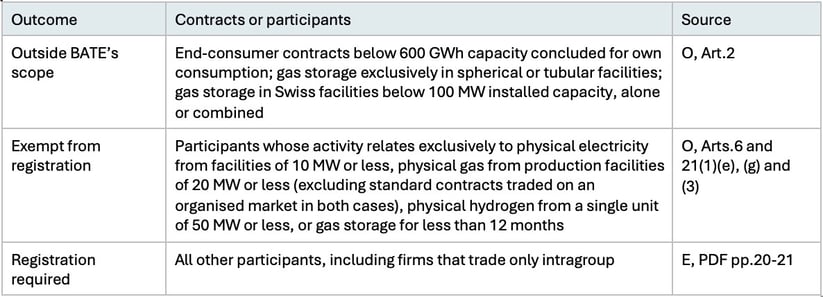
VATE distinguishes between contracts excluded from BATE’s scope, activities exempt from registration and transactions reported only upon request. Each requires a separate assessment. Table 2 summarises the first two, and Theme 3 covers the third.
Table 2. Scope and registration outcomes under VATE
The registration exemptions apply only where a participant’s activity falls exclusively within the qualifying categories. Intragroup trading and the small gas-supplier reporting relief do not create a registration exemption, and the explanatory report expressly requires registration for participants conducting only intragroup transactions (Doc: O, PDF p.5, Article 6; E, PDF pages 20-21).
Firms reviewing whether their activities fall within BATE’s scope should start by identifying every group entity that trades Swiss wholesale energy products, including companies that trade only intragroup. For each entity, firms should document the basis for any scope exclusion or registration exemption and identify the relevant reporting category. Firms already maintaining a REMIT inventory can build on that work by adding the Swiss assessment.
Industrial groups near the 600 GWh line need a documented calculation of consumption capacity, meaning what their installations would consume running at maximum capacity for a year rather than what they actually buy. The calculation should aggregate affiliates that operate as one economic unit. It should be rechecked whenever installations change (Doc: O, PDF pages 1-2, Articles 1(a) and 2(2); E, PDF pages 13–14).
Small producers relying on the registration exemption need a similar check on their trading activity. The exemption applies only where a firm's activity relates exclusively to physical supply from small facilities. A producer that begins trading standard contracts on an organised market, such as an exchange or broker platform, loses the exemption and must register with ElCom (Doc: O, PDF pages 5 and 14, Articles 6 and 21(1)(e); E, PDF p.20).
Under Article 39, a participant that files its registration application by 28 February 2027 may keep trading Swiss products until ElCom notifies them of its decision. A firm that files later has no transitional right. Because BATE requires registration before trading, it is inferred that a firm should expect to suspend Swiss trading until ElCom registers it. Foreign participants must also submit their Swiss representative’s details to ElCom by 1 June 2027. Registration applications must state whether the firm conducts algorithmic trading or provides direct electronic access to an organised market, and changes must be notified without delay (Doc: O, PDF pages 3-5, 24 and 26, Articles 4-7, 34 and 39; E, PDF pages 19 and 73-75).
Theme 2 - Existing REMIT processes can support compliance with separate Swiss requirements applying
The explanatory report states that VATE is “deliberately based” on the EU Commission's Implementing Regulation (EU) 2026/256 (the revised REMIT data-reporting regulation) to reduce duplication for firms active in both markets. It also confirms that the two supervisory frameworks remain separate (Doc: E, PDF p.7, section 3.1).
“The provisions are in line with the relevant EU regulations; however, they do not entail integration into the REMIT system. Furthermore, this is by no means a dynamic transposition of EU law.”
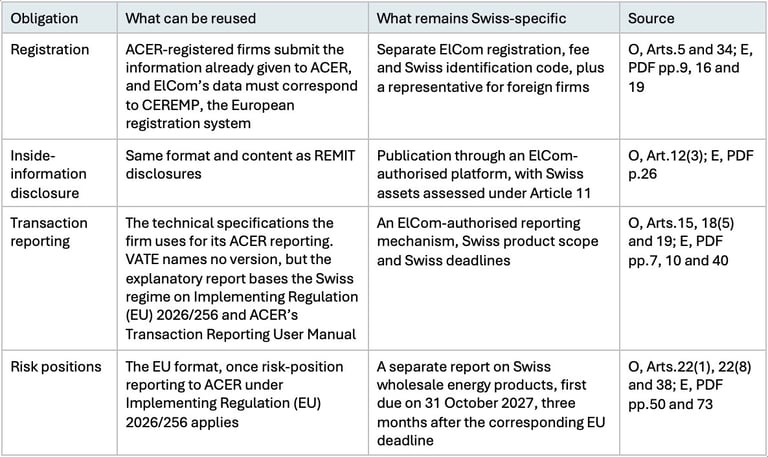
VATE provides several ways for firms to reuse existing REMIT arrangements, summarised in Table 3. In each case, ElCom may request supplementary information where the EU standard does not meet Swiss requirements.
Table 3. REMIT arrangements applicable to VATE
Swiss-established firms registered under REMIT also act as participants in the European market. They must send ElCom a copy of the transaction data they report to EU authorities on their trading in EU wholesale energy products. Once EU risk-position reporting applies, they must also send ElCom their EU risk-position reports. Both copies must be identical to the EU submission and sent at the same time and in the same format (Doc: O, PDF pages 10-12 and 17, Articles 17(4) and 22(7); E, PDF p.3, section 1.2). The duty is not new for electricity. It carries over Article 26a(bis) of the Electricity Supply Ordinance (click here for ElCom's description of the current duty, here for Frequently asked questions (FAQs) regarding Article 26a, and here for the ordinance), which VATE repeals from 1 January 2027, and BATE now extends it to gas (Doc: O, PDF p.27, Article 41; E, PDF p.76). Firms already reporting under Article 26a(bis) must continue without interruption from 1 January 2027, while others have until 31 March 2027 (Doc: O, PDF p.26, Article 37; E, PDF p.73). Around 200 Swiss-domiciled persons appeared in ACER's register on 4 August 2026 (Doc: E, PDF p.8). ElCom receives this data for oversight but has no power to sanction conduct in EU products, which remains a matter for ACER and EU national regulators (Doc: E, PDF p.60).
ACER-authorised inside-information platforms (IIPs) and registered reporting mechanisms (RRMs) still need ElCom authorisation, through a simplified route without technical re-examination. Platforms must give ElCom secure access to published information. Reporting mechanisms must transmit securely in a format ElCom can process automatically. Both must keep records for five years (Doc: O, PDF pages 6 and 9, Articles 9 and 15; E, PDF pages 21-23 and 30-32).
The documents identify several deliberate departures from REMIT (Doc: O, PDF pages 12-15, Articles 18(2), 19(3) and 21(1); E, PDF pages 37-38, 44 and 46-48).
Non-standard contracts without a fixed price and quantity have a deadline of 30 working days, compared with ten working days under the revised REMIT rules.
Hydrogen products are reported on request rather than annually.
Purely domestic gas purchases by small gas suppliers are also reported on request.
Swissgrid’s balancing reports must contain non-aggregated 15-minute electricity load profiles, while gas transmission operators report hourly aggregated profiles. Most participants therefore need no change to their feeds for this requirement.
ETRC conference insight. Ms Kawann explained that REMIT-registered firms could download their CEREMP record, upload it to ElCom’s system and add the information required for Swiss registration. Industry respondents had proposed this route during the consultation. Once an application is approved and the fee paid, ElCom assigns an identification code and enters the firm in the register. Ms Kawann said that exchanges such as EPEX Spot would require that code for trading Swiss products. Firms relying on Article 39 to trade before they receive a code should confirm how their exchanges will treat pending applications (Doc: C, PDF p.5, section 2.2.3; O, PDF pages 4 and 26, Articles 5(4) and 39).
Firms adapting REMIT arrangements should map each process against Table 3 and extend their inside-information procedures to Swiss assets. Transaction reporting needs clear ownership and the correct Swiss deadlines, and risk-position reporting needs to cover the Swiss product scope.
Technology and Operations should validate that current systems can capture and submit the required information bearing in mind that final designs under the revised REMIT reporting rules are still work in progress and hence not quite a ready-made template. Legal and Procurement should confirm that agreements with each reporting mechanism (RRM) and inside-information platform (IIP) cover Swiss products and services.They should also check that each provider appears as authorised in ElCom's public registers. Firms delegating reporting to a counterparty should confirm that the delegation agreement covers Swiss reporting and that the report reaches ElCom through an authorised mechanism. All these agreements should secure access to submitted records and define how errors will be corrected.
Firms that do not already report to ACER under REMIT cannot rely on Articles 18(5) and 22(8) of VATE. Those provisions let firms that report transactions to ACER reuse their EU reporting format, and let firms use the EU risk-position format once that reporting applies in the EU. Firms without an ACER reporting history include Swiss-only traders, many DSOs and utilities, and large end consumers. ElCom will take account of the annex to Implementing Regulation (EU) 2026/256 and ACER's Transaction Reporting User Manual when it sets Swiss formats. The explanatory report refers to a version of that manual published in December 2024, before the new REMIT II regulation, and notes that ACER revises it frequently. Building to the current EU standards is therefore a reasonable starting point, but firms should expect to adapt as ACER updates its guidance in context of REMIT II and ElCom issues its own. Firms that already report under REMIT should also check which version of the EU reporting standards their systems support (Doc: O, PDF pages 13 and 17, Articles 18(5) and 22(8); E, PDF pages 7, 10 and 75).
Theme 3 - Reporting responsibility depends on the contract and how it is traded or amended
VATE assigns reporting responsibility according to whether a contract is standard or non-standard and where it is traded. A contract is standard when it is admitted to trading on an organised market, a term that covers energy exchanges, energy brokers and capacity platforms. Two firms can also agree the same contract bilaterally. It remains a standard contract if its terms, including the delivery point or zone, match those of the exchange-traded contract. For example, if two firms agree bilaterally a Swiss baseload monthly contract with the same terms as a contract listed on an exchange, their trade is a standard contract. Because it was not traded on the exchange, the two firms must report it themselves. A contract that is only similar to a listed contract, or that is negotiated on bespoke terms, is non-standard (Doc: O, PDF pages 1 and 10, Articles 1(b)–(c) and 17(1); E, PDF p.12).
Organised market operators report standard contracts traded on their markets. Participants report standard contracts traded outside an organised market and all non-standard contracts. Reporting can split between the two once a trade has been done. As an illustration, suppose two firms trade a standard contract through a broker platform, which counts as an organised market and which reports the trade. If the firms later agree directly to reduce the volume or end the contract early, the platform has no record of that change. VATE therefore requires the two firms to report it themselves. The same applies to any amendment, cancellation, correction or early termination agreed outside the venue (Doc: O, PDF pages 1 and 10, Articles 1(d) and 17(1)–(2); E, PDF p.35).
Off-venue transactions are in principle reported by both parties. Participants may delegate reporting to a counterparty or a reporting mechanism, and a delegated report must contain both counterparties’ data. Participants without their own authorised reporting mechanism must delegate to an authorised mechanism (Doc: E, PDF pages 35 and 82-83).
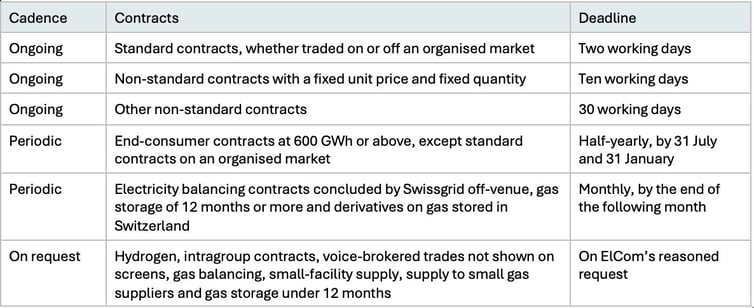
The reporting cadence depends on the contract category.
Table 4. Reporting cadence by contract type
Source: Doc O, PDF pp.13–16, Articles 19–21; E, PDF pp.41–48.
The ten-working-day category applies only where both price and quantity have been agreed. A contract priced off the spot market or sized to a wind farm’s output falls into the 30-working-day category. For auctions, the deadline runs from the auction’s end, and only concluded transactions and final orders are reported (Doc: O, PDF pages 13-14, Article 19(2) and (4); E, PDF pages 41-44).
Article 21(1)(b) limits reporting of intragroup contracts to cases where ElCom makes a reasoned request. The relief covers only trades between companies in the same consolidated group that appear in the same consolidated accounts. The explanatory report justifies it on the basis that such trades are not concluded on the open market and generally send no price or liquidity signals. ElCom can still request for them to be reported where it suspects that a group has used internal trades to create or conceal a market position. The relief does not extend to standard contracts traded on an organised market, which group companies must continue to report on an ongoing basis (Doc: O, PDF p.14, Article 21(1)(b); E, PDF p.47).
Request-only treatment changes how often contracts are reported, but the contracts stay within BATE’s scope. Intragroup-only firms must still register, and intragroup positions still appear separately in risk-position reports (Doc: O, PDF p.16, Article 22(3)(c); E, PDF pages 20-21 and 50).
ETRC conference insight. Ms Kawann described the possibility of establishing a direct interface with ElCom. Any such route must meet Article 15’s conditions on secure transmission, automated processing and retention. Inside-information disclosure requires a separately authorised platform, although VATE does not prevent one provider from holding both authorisations (Doc: T; O, PDF pages 6 and 9, Articles 9 and 15).
Firms should record each contract’s classification when the trade is booked. The classification decides who reports the trade and whether the deadline is two, 10 or 30 working days. Operations should manage submissions and corrections, and Compliance should check the category and deadline.
Lifecycle events need particular attention. A broker platform may report the original trade, while a later amendment agreed directly between the counterparties falls to them to report. Trade records should link the two events and identify the reporting party for each. Intragroup and other request-only contracts should be kept complete and in a readily reportable format, so the firm can answer an ElCom request promptly.
Delegation agreements should specify which Swiss obligations the provider covers and confirm that both counterparties’ data will be reported. They should also define access to submitted records, error escalation and the transfer of records when the service ends. Article 17(5) entitles participants to obtain the data that organised markets submit on their behalf. Firms should use that access to test the submissions for completeness and accuracy and to correct any errors. Participants and organised markets must retain reportable information for at least five years from the action, and the period is suspended during ElCom proceedings (Doc: O, PDF p.12, Article 17(5)-(6); E, PDF pages 35-36).
Ms Kawann’s comments on cross-border cooperation support keeping mappings between Swiss and EU identifiers for related trades, so firms can answer enquiries from either jurisdiction. VATE provides for a register of foreign supervisory authorities (Doc: T; O, PDF p.2, Article 3(1)(c)).
Theme 4 - Inside information creates disclosure duties and trading restrictions
Article 11 identifies inside information that could significantly affect Swiss wholesale energy prices. It covers information about Swiss generation and storage facilities with installed capacity of at least 100 megawatts (MW), alone or in combination, together with electricity transmission facilities and specified gas pipelines. The explanatory report describes this list as non-exhaustive. Participants must therefore assess case by case whether other information could significantly affect prices, including information about very large consumption facilities (Doc: O, PDF p.7, Article 11; E, PDF p.25).
The 100 MW figure follows the threshold set in EU market transparency rules, notably Commission Regulation (EU) No 543/2013, the EU Transparency Regulation (click here). The explanatory report notes that the EU is reviewing this threshold but does not specify which regulation although it can be inferred it relates to REMIT. It explains that Switzerland retained 100 MW to stay aligned with current EU standards while that review continues (Doc: E, PDF pages 25 and 80).
Combined capacity includes hydroelectric complexes, aggregators and virtual power plants whose bundled assets reach the threshold. During the consultation, gas-sector respondents proposed a 500 MW threshold, and several electricity-sector respondents asked that aggregators and virtual portfolios be excluded. The approved text adopts neither proposal (Doc: O, PDF p.7, Article 11(2); E, PDF p.25; C, PDF pages 5-6, sections 2.2.1 and 2.2.5).
Each inside-information announcement must include a notification reference number and the date and time of publication. It must identify the publishing participant by name and Swiss identifier. It must also state whether the event is ongoing or completed, give its start and end times and explain its circumstances and consequences. For planned or unplanned facility unavailability, Article 12 additionally requires the following details.
Facility identification and capacity. Name the facility and state its available, unavailable and installed or technical capacity.
Location and affected market area. Identify the facility’s location and the affected bidding or balancing zone.
Nature of the event. State whether the unavailability is planned or unplanned and describe the incident’s main characteristics.
Measurement and energy source. Specify the unit of measurement and the energy source concerned.
Reason for the unavailability. Explain the cause, or state that it is unknown and update the announcement once it is established.
Firms deferring disclosure must give ElCom their identification number, the disclosure details, the duration of the deferral and the reasons, using ElCom’s form (Doc: O, PDF pages 3 and 7-8, Articles 4(1)(e), 12 and 13).
Article 24(1) makes clear that the prohibition on exploiting inside information also covers changes to existing trading orders. A trader who learns inside information about an outage cannot use it to cancel or amend an order simply because the order was placed before the trader knew about the outage.
Article 24(2) adds two exceptions drawn from REMIT. The first concerns fulfilling an obligation that has fallen due and was entered into before the participant became aware of the inside information. The second allows electricity generators, gas producers and storage operators to cover direct physical losses caused by an unplanned outage. That activity must be necessary to fulfil pre-existing statutory or contractual obligations. Alternatively, it must have the consent of Swissgrid or the relevant gas transmission operator and support the safe, efficient and effective operation of the network.
For example, a generator may unexpectedly lose production needed to fulfil an existing electricity-delivery contract. The physical-loss exception may allow it to purchase the missing electricity where necessary to meet that commitment. Additional trading beyond covering the direct physical shortfall does not benefit from the exception (Doc: O, PDF pages 18-19, Article 24(1)-(2); E, PDF pages 55-57).
Firms implementing BATE and VATE should start by agreeing how information about Swiss assets reaches the people responsible for disclosure and trading decisions. Asset teams should provide timely information and updates, while Compliance and Legal set the assessment criteria and escalation process. Firms operating aggregated or virtual portfolios should test combined capacity against the 100 MW threshold. Records should show when information became available, the reasons for each disclosure decision, when trading restrictions took effect and each later update. Trading controls need to cover amendments and withdrawals of existing orders as well as new orders (Doc: O, PDF pages 7 and 18, Articles 11 and 24(1); E, PDF p.25).
Firms relying on the physical-loss exception should be prepared to document the outage’s effect on their obligations. They should show that each resulting trade was necessary and limited to covering the direct physical shortfall. Where a firm relies on the grid operator’s consent rather than on its existing obligations, Article 24(3) requires it to inform ElCom. EPEX Spot noted in its consultation response that this consent is not public and cannot be verified by exchanges, so exchanges may still file suspicious transaction reports in relation to this activity. A prompt notification to ElCom gives the firm a contemporaneous record of its reliance on the exception. In RegTrail’s view, the exception does not suspend the separate disclosure obligation (Practitioner inference) (Doc: O, PDF pages 18-19, Article 24(2)-(3); E, PDF pages 55-57; C, PDF p.9, section 2.2.8).
Firms should confirm that their publication platform keeps announcements visible for five years and that the service agreement covers transfer of that history if ElCom withdraws the platform’s authorisation. Firms should also retain the commercial and operational evidence behind their trading decisions. ElCom will rely on that evidence when it assesses under Article 25(3) whether conduct had a justified reason or reflected accepted market practice (Doc: O, PDF pages 6-7 and 20, Articles 9(1)(b), 10 and 25(3); E, PDF p.57).
Disclosures made in the course of business also need a documented process. Article 24(4) covers a disclosure needed to conclude a contract only where the holder warns the recipient against using or passing on the information and documents both steps. Firms can apply this through existing procedures for joint ventures, offtake negotiations and asset transactions (Doc: O, PDF p.19, Article 24(4); E, PDF p.57).
Article 22 requires Swiss-market participants to report their risk positions in Swiss wholesale energy products, whether physically or cash-settled, for the 18 months after each reference quarter. Positions are taken as at the quarter’s last day and aggregated by month. They are split between electricity and gas, by delivery point or zone and by product type, with intragroup positions shown separately from those held with external counterparties. Reports are due by 30 April, 31 July, 31 October and 31 January (Doc: O, PDF p.16, Article 22(1)-(3)).
The first report is due on 31 October 2027 for the July-September 2027 quarter. On RegTrail’s reading of Article 22, it reflects positions held on 30 September 2027 and covers October 2027 to March 2029. The explanatory report states that the Swiss deadline falls three months after the corresponding EU deadline for operational reasons. Because the report looks forward, day-ahead and intraday activity falls outside its scope (Doc: O, PDF p.26, Article 38; E, PDF pages 50 and 73).
Participants whose cumulative positions are below 600 GWh a year are exempt from regular submission. The test is run at year end, separately for electricity and gas, using absolute monthly values so that long and short positions cannot offset each other. Swissgrid, gas transmission operators, DSOs and storage operators that buy energy solely to operate their networks report only at ElCom’s request. ElCom may also ask reporting participants for their expected Swiss generation and their projected consumption under concluded contracts. The explanatory report says that this lets ElCom assess trading activity against a firm’s production and supply obligations (Doc: O, PDF pages 16-17, Articles 22(4)-(6); E, PDF pages 51-53).
The explanatory report gives two examples, drawn from the REMIT revision, of how position data explains trading activity. In Example 1, a group trading company appears to hold a short position until generation and supply contracts elsewhere in the group are taken into account. In Example 2, a company holds a long trading position because its own generation cannot meet its customer supply commitments (Doc: E, PDF pages 50-51, Examples 1-2).
The Swiss approach follows the revised REMIT framework. Risk-position reporting is a new obligation in both regimes. Article 22(8) lets firms that report positions to ACER under the revised rules reuse the EU format, and the first EU deadline falls three months before the first Swiss report (Doc: O, PDF p.17, Article 22(8); E, PDF pages 50 and 73). ElCom may request additional information where that format falls short of Swiss requirements. The Swiss report still has its own scope, so firms building it from a wider European dataset must isolate positions in Swiss wholesale energy products. Several consultation respondents warned that a Swiss-only report would need its own systems and data models. Others asked for an exemption for firms trading only request-reportable contracts. The final ordinance retains the Swiss report and contains no such exemption (Doc: O, PDF p.17, Article 22(8); E, PDF pages 50 and 53; C, PDF pages 8-9, section 2.2.7.3).
Swiss firms that are also participants in EU wholesale markets have a separate duty under Article 22(7), described in Theme 2. That duty runs on the EU timetable and does not wait for the first Swiss report. The ElCom copy should match the EU submission in full rather than being filtered to Swiss positions (Practitioner inference) (Doc: O, PDF p.17, Article 22(7)).
Firms should run a data-readiness test well before the first Swiss report on 31 October 2027. A practical test is to produce a trial report from a recent quarter-end, using the structure Article 22 requires. That structure covers positions in Swiss products only, broken down by delivery month for the following 18 months. It also splits positions between electricity and gas, by delivery point or zone and by product type, and shows intragroup positions separately. Any field the firm cannot populate from its trading systems shows where it needs to build or source data before reporting begins. Intragroup positions stay in the calculation even where the underlying contracts are reportable only on request. Risk should lead the calculation methodology, with Legal supporting contract classification and Compliance checking regulatory scope and exemptions (Doc: O, PDF pages 16 and 26, Articles 22(1)–(3) and 38).
The 600 GWh risk-position exemption needs its own annual calculation, separate from the end-consumer capacity test in Theme 1. Technology and Operations should ensure that each submission can be reproduced and reconciled to the underlying records, with differences explained.
Firms should retain the commercial rationale for material positions and know where generation and supply forecasts are held, so they can respond to ElCom requests. Firms already building REMIT position reporting can use the three-month gap between the EU and Swiss deadlines to validate the Swiss output. Newly affected firms will need to establish the methodology and controls from the outset.
Theme 6 - Phased implementation requires firms to separate data capture requirements from submission deadlines
VATE enters into force on 1 January 2027, but most obligations follow transitional timetables. The explanatory report explains that ElCom may not have authorised any inside-information platform or reporting mechanism by that date. The deferrals therefore postpone submission while the obligations themselves apply from 1 January 2027. A firm using the disclosure deferral must, by the end of its deferral period, publish on an authorised platform every disclosure it should have made since 1 January 2027. In practice that is a backlog of urgent market messages (UMMs), due by 31 May 2027 for existing REMIT publishers and by 31 December 2027 for other firms. Firms may publish earlier, and a firm that publishes in real time from 1 January 2027 avoids building a backlog. Participants and organised markets using the reporting deferrals must likewise submit all transactions carried out since 1 January 2027 (Doc: O, PDF pages 24-25, Articles 35-36; E, PDF pp.65-69).
A firm using the disclosure deferral must, by the end of its deferral period, publish on an authorised platform every disclosure it should have made since 1 January 2027. In practice that is a backlog of UMMs, due by 31 May 2027 for existing REMIT publishers and by 31 December 2027 for other firms. Firms may publish earlier, and a firm that publishes in real time from 1 January 2027 avoids building a backlog. Participants and organised markets using the reporting deferrals must likewise submit all transactions carried out since 1 January 2027 (Doc: O, PDF pp.24-25, Articles 35-36; E, PDF pages 65-69).
Article 36(4) sets later start dates for three categories, and these work differently. Reporting for electricity storage contracts and derivatives on electricity stored in Switzerland starts on 1 November 2027. Reporting for gas storage contracts, derivatives on gas stored in Switzerland and order-matching system data starts on 1 May 2028. Reporting for hydrogen products starts on 1 July 2028. These dates follow the timetable in Implementing Regulation (EU) 2026/256. Each obligation begins only on its stated date, so there is no backlog to report from 1 January 2027 (Doc: O, PDF p.25, Article 36(4); E, PDF pages 69-71).
Respondents criticised the consultation draft’s 31 March 2027 reporting start as leaving insufficient preparation time, and the approved timetable moves participants’ deadlines to 31 October or 31 December 2027 (Doc: C, PDF pages 4 and 10, sections 2.1 and 2.2.11; O, PDF p.25, Article 36).
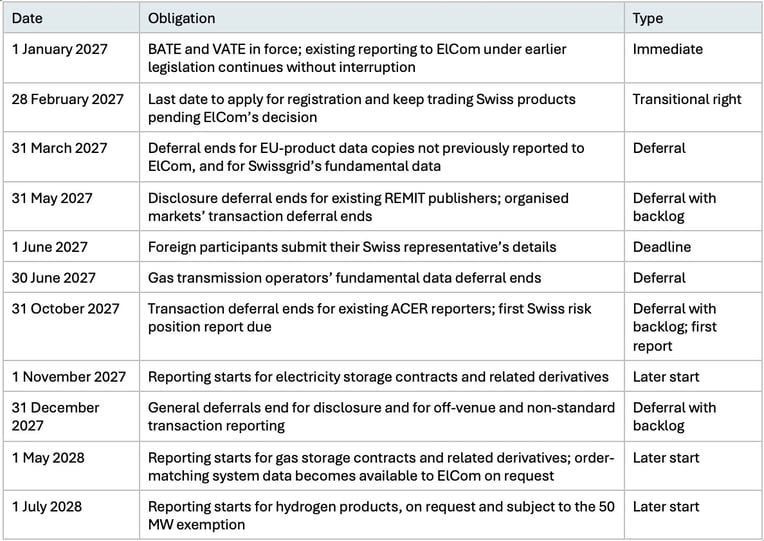
Table 5. Obligations by commencement date
Source: Doc O, PDF pp.24–26, Arts.21(5) and 34–39; E, PDF pp.65–75